- 261026
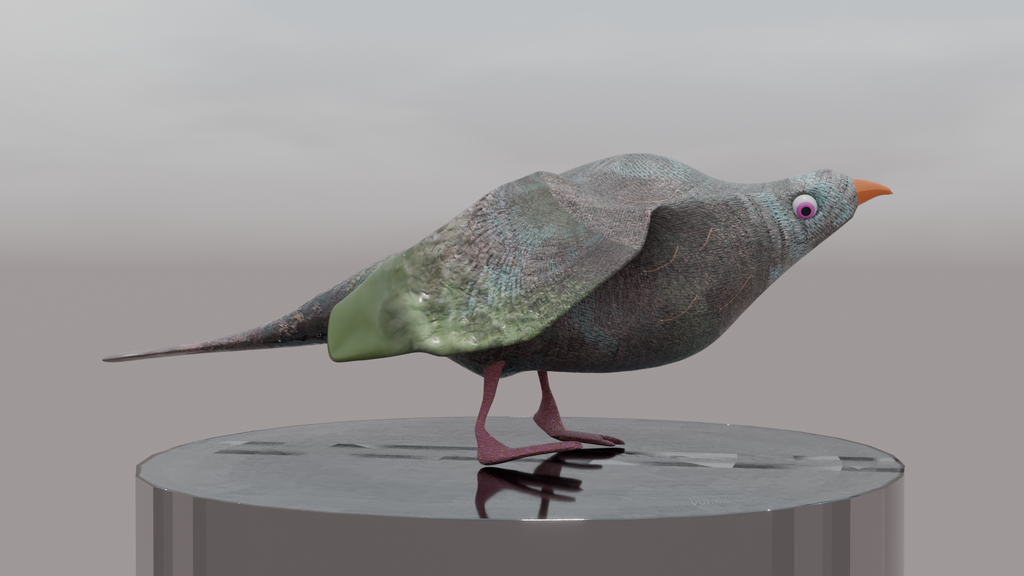
Saint of Doves
All stories have an end
before they can become new.
When you’re a child, you can, like a
mystic, glimpse the infinite.
World-builders with ketchup
all over their faces.
To grow up is to
crush worlds and build them.
Lego, different pieces puzzled together, changed.
There is always a plan, but suddenly
it happens.
Everyone has an account.
An account that ties us to
reality.
A buoy, an anchor, a bridge, a yoke.
I look at faces.
Fantasies in a book.
A reality greater than me.
Out there.
To navigate, not to exist in.
A world like others,
a world not like others.
An otherworld,
beside an anyworld.
There is a value in preserving
the memory of something that was important.
It travels between mouths,
lungs, ears, eyes, tongue and
thin skin.
And I feel how
the 90s smelled.
To maintain or to uphold.
Are they so different?
Or is it a power relation.
Some places have:
grown, sunk, been broken, been patched.
It rests in the place itself.
In layers of gravel and macadam.
In a past that reveals itself
we may perhaps glimpse
our future.
The pigeons see the now in the crumbs.
They eat from boxes even if they’re poisoned.1
I’m now a little bit over half my time here in Athens. Last week I had a quick visit back to Stockholm and, to little surprise, had that slight foreign feeling you can get when returning home after some time away. Going ‘somewhere’ does not necessarily give you the strongest realizations about the place you are going to, but, as my favorite anthropologist Michael Taussig would argue, it teaches you mostly about the place you are from. So, instead of focusing on what I am trying to find in Athens, I would like to speculate on what I am feeling is missing where I normally exist.
I have this feeling that we caught the world in a fall. Not the bigger world, but the world I inhabit normally: Sweden and northern Europe. While society increases its economy, it seems to somehow do so at the expense of myth and imagination. Two components retracted from a society that desperately needs to reinvent the human in the technological age. Somehow braided into the logic of our society itself, the activity of fantasizing, or lying for the fancy of a tale, is reduced to cheap entertainment instead of being understood as the foundational playground for our spiritual development. Many people in the world at the moment can sense that something is wrong with the setup we have created. Some escape into increasingly dogmatic religious beliefs, or ideological equivalents, enamored by the familiar feeling of something old and filled with passion. Maybe they are trying to find the flank at which to die with conviction?
“Confronted by the difficult task of learning how to die well, subjects standing at the tail end of a future often feel that their world-building aesthetic machine is beginning to jam.”
… Federico Campagna writes in one of the final chapters of the book Prophetic Culture. I think this precise notion is what has fueled my work as an artist for the past decade. As an artist I often feel confronted by the conflict of creativity as a labor and creativity as a vessel for something much less tangible. The naming of this second one has a lot less to do with everything measurable and quantifiable. For lack of better explanations, it is as if the world I inhabit has buried this notion, or reason, for creativity so far underneath the layers of language that constitute contemporary life that it falls into the sensations of madness or mysticism.
All of us are seeking means to sustain ourselves in a world that twists and turns like a huge ship on a stormy sea, most of us passengers forced to adapt far away from the helm. Even the galleries, book publishers and record labels are forced to go on a similar journey. One that always leads you to pay homage to increasingly rigid frameworks of cultural production. An image in my head paints Stockholm as a ship and its crew at port, tied not only with rope to the harbor but also tied through new trade opportunities, bastard children, imprisonment from not understanding the rules of the harboring country, or lost in the maze of foreign architecture. Athens still feels like a ship on the coast, trying to decide where, if and when to throw anchor.
2
I think it comes as no surprise that in a reality motivated at its core by economic growth, the productivity of any action is always in question. Why do X, and what is the purpose of Y? There is a moral at stake somewhere in the action of creation, and there is a fine line between a lack of purpose and an escape from purpose. How many times have we not heard discussions of art for art’s sake as a plaything for the upper class, entertainment for an academic elite, or masturbatory activity for egocentric artists?
If artistic endeavors are world-building, what kind of worlds are built when motivated by purpose?
I went through our academies in the early 2000s, taught by post-modern teachers coming from the post-modern schools and Conceptual Art. A way of looking at making where the thought produces the work. A strong way of unmasking the very white, male-dominated world of modern art that came before it. A huge wrestling match between the old champs and the coming ones, but still in the same arena. A playing field where “purpose” is central and the idea of aimless creativity is naive and/or suspicious. I remember a professor of mine writing my work off as shamanistic at one point, saying he experienced it as obtuse and as using language as a way to hide intention, in this way deprecating language itself. Something this professor viewed as “witch doctor aesthetic”, or theatrics without purpose. His main point, as I think of it today, would be how the flooding of meaningless “things” in the world just drowns us without giving us anything to hold on to.
Since then the world has entered a new era of internet, ecological crisis, AI and migration. Also, for us in Europe specifically but generally everywhere, a centralization of wealth after many events of economic collapse. The economic growth concept has moved into many segments of our society. Personal growth, emotional growth, brand growth, spiritual growth. Everything must grow, it seems. In the same way, the biggest achievement of an artist today is the size of their fame in itself. How many Picassos and Warhols have we not seen around the world? A story worth telling because of its success. And are we not smart enough to realize that this means success and visibility are what must grow to create the artistic prophets of the future under western capitalism? Learning from the success stories of social media and its magical algorithms, what is being appreciated, or at least looked at, has become a currency in itself.
Purpose, and how it is questioned, is in this sense judged in two separate but tied-together ways. The first is visibility, mentioned above, which forms a necessity for anything to be appreciated as art. The second is affiliation, meaning: what does this art serve? Once visible, and once what the art serves has been laid bare, it can be used by others to populate a location in the continuous world-building of the contemporary world we still inhabit. It’s an industrialized way of producing and developing culture, increasing output and diversity inside a system at the cost of imagining something outside of it.
Simultaneously, the need for something outside of this effective machine seems absurd for anyone besides the artist. Just as surrealism needed psychology and ideology to legitimise its surge of imagination, so would any artist wanting to imagine outside of this world need to invent reasoning to exist inside of it. There most definitely is a mould to follow, of common language and expectations of behavioural patterns among artists, gallerists and collectors. Something that has only hardened with competition and the increasing stress upon a world that seems to be heading for collapse.
In Athens you can visit the gallery district in Piraeus. It is the same as the gallery district in Stockholm, Copenhagen or Berlin. It tells me that Athens is simultaneously a place where artists struggle and adapt, or don’t, like anywhere under the rigid machine of contemporary art. Simultaneously, the scope of the city and the abundance of cheap space create a breeding ground for alternative forms of imagination that have mostly been pushed out of existence or institutionalised in Stockholm. The same old story of gentrification and its relationship to contemporary art. My question would be: can art affect this transformation itself if we could be less complicit in the arena that inevitably chokes us? Does it have less to do with where we are, and more with the kind of artistic languages we regurgitate?
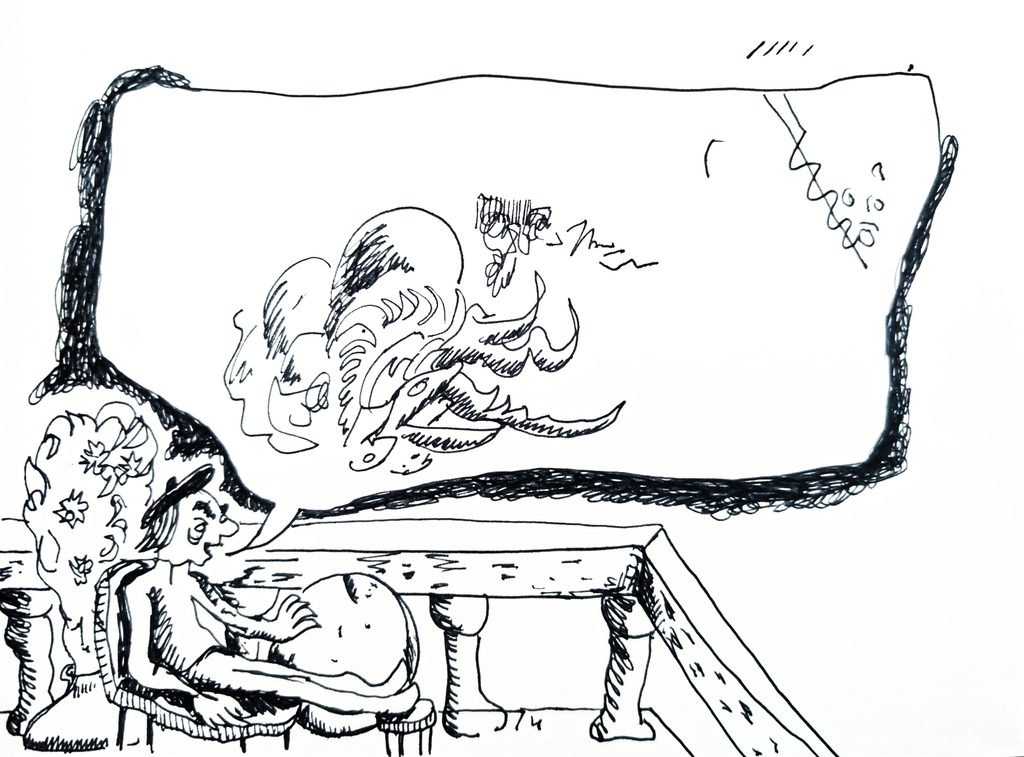
“Lying Artist on Balcony”, Napkin Sketch, October 2026 by Me Any relatively well-off western country exists in this aesthetic spiral where the hardening of the models for making art is stricter. Where the economy for sustaining yourself is more challenging, and the engine that drives you to produce outside a well-established machine is consistently challenged. It’s a kind of “Midas trap”, where the wealth of a system and its stability bind you to this same wealth and proliferation. Being an individual who steps outside of this proliferation of wealth is dangerous. Don’t fix what is not broken, yet. Compare this to areas of systemic collapse, where the chaos of unknown direction will allow for all kinds of realities and worlds to start taking shape. Societies with less to lose can truly work without purpose, relying on the hope that what feels correct should have a good outcome, or on whatever other idea that seems absurd under contemporary western life.
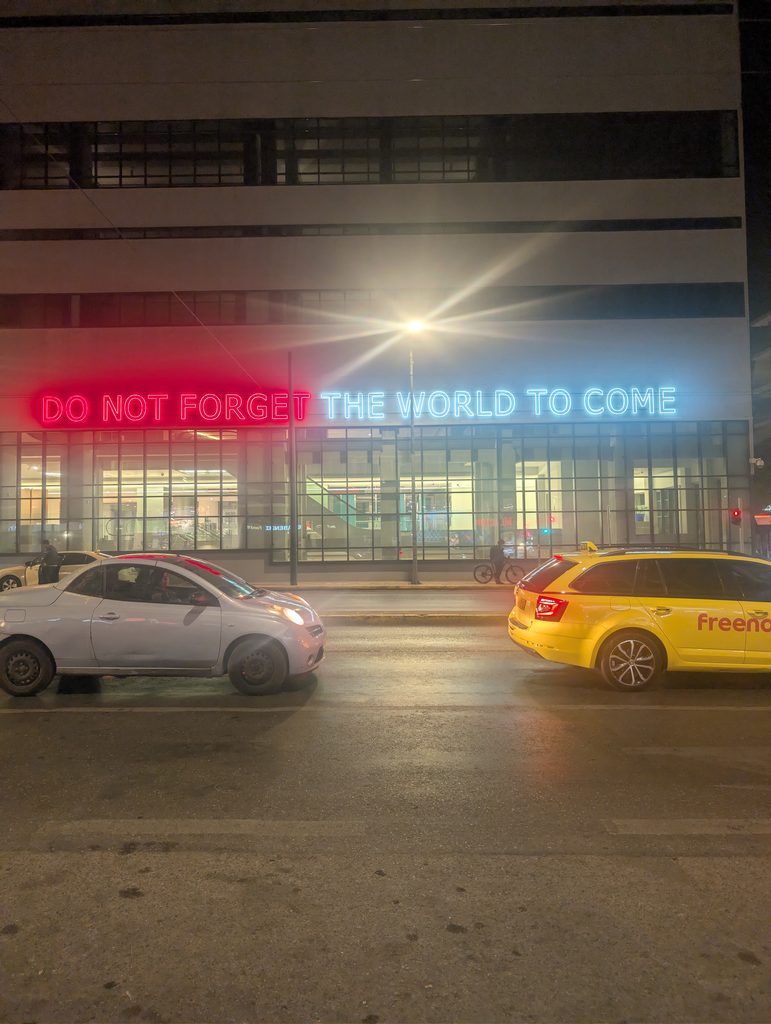
Neon signs outside of The Modern Museum of Contemporary art in Athens This is not to paint places of economic strife as possessing something that puts them in a better position compared to Switzerland or any other rich western country. It is a position inherited from the mechanics of the system itself. In the Museum of Contemporary Art in Athens they are right now showing their exhibition “South by South-East”, an attempt to frame Athens in a new artistic context related to the Mediterranean area instead of replicating the stories of North American and Eurocentric art histories. It’s a commendable effort that opens a small strait for sailing your ship past the ports already populated and exhausted. An act of resistance not equally possible in a country like Sweden, where the debt to the machine that feeds the society itself means it cannot afford to leave the game it is constantly reinforcing.
As I mentioned in previous texts, to inhabit the location of the “Anyplace” means always pointing towards its logical centre. What would happen if that centre were to disappear or lose its function as stabiliser of the world you exist in? And, more importantly, isn’t it more relevant to point somewhere else (or maybe even better, into nothingness) before that happens?
When I think about the place I am from, I see it as a missed opportunity for artists not to detach more strongly from the expectations of the system we exist in. Hopefully discovering places of thought that those who are not artists, but designers and technologists, can explore further. The aimless wandering in deserts to find the scraps of past civilisations, or an oasis to fill your water, cannot come from a strategic removal of all sand. Instead, the walking, looking, sensing, finding, reacting, evaluating and eventual production of some sort of trace seem more tangible as something meaningful.
Περιδιαβαίνοντας τον Γιάννη Χρήστου, Moving through Jani Christou